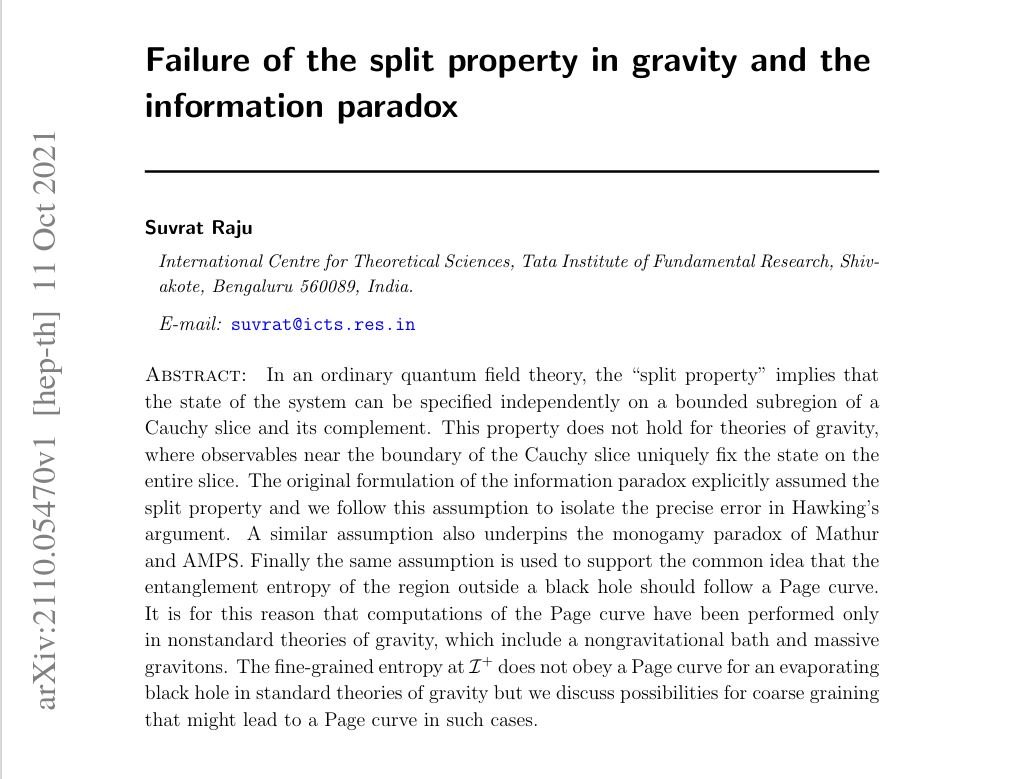
The CQG journal is bringing out a special issue on the recent developments on the Page curve and the editors invited me to contribute something. So I took the excuse to write a “perspective essay” on the topic that appears on the arXiv today: https://arxiv.org/abs/2110.05470
The essay focuses on an incorrect assumption that plagues many discussions of black-hole information. The assumption, loosely speaking, is that the Hilbert space in gravity should factorize the way it does in QFT and so one can specify the state of a system independently inside and outside a bounded region.
Of course, it is not hard to see why this is appealing. The assumption holds in nongravitational field theories. It even has a nice formal name: “the split property”. And, in general relativity, one can find solutions that differ inside a bounded region and coincide outside. But this assumption fails when both quantum mechanical and gravitational effects are important. Instead theories of quantum gravity obey a “principle of holography of information” … once all observables outside a bounded region have been specified, the state inside the bounded region is completely fixed.
One immediate objection is: “we live in a world where gravity is presumably quantized, but we make local operations all the time.” Of course, even in gravity one can construct approximately local operators if one neglects effects suppressed by (typical-energy scale/Planck scale). This ratio is negligible in everyday life, and so our experience is well described by such approximately local operators. But if one starts asking fine-grained questions about the entanglement entropy in a gravitational theory then the fact that these operators are only approximately local and not exactly local becomes important.
This issue is definitely important for questions of black-hole information since the typical energy scale is the Hawking temperature and (Hawking temperature/planck scale) is just the inverse of the black-hole entropy. Therefore, if one tries to take the Planck scale to infinity to get rid of these unusual gravitational effects this throws out the baby with the bath water: the entropy diverges and there is no meaningful question left to ask about black hole information.
For this reason, it is impossible to ignore the unusual localization of quantum information in quantum gravity for questions of black-hole information. If one insists on taking intuition from local QFT/classical GR seriously, this often leads to a paradox.
People sometimes ask: “where is the mistake in Hawking’s argument for information loss?” The mistake is that Hawking assumed factorization of the Hilbert space up to the constraints of the no-hair theorem. The assumption is quite explicit in Hawking’s paper, and I even included a quote from the specific paragraph in the original paper to point out precisely where the error was made.
The same incorrect assumption of factorization/locality led to the monogamy paradox of Mathur, which was later revived by AMPS.
And the same incorrect assumption underlies the idea that the entropy of black-hole radiation should follow a Page curve.
In fact, it is because this assumption fails in standard gravity that, in the recent literature, the Page curve has only been computed in theories with a nongravitational bath and massive gravitons that do not obey the Gauss law. These computations are nice, but these models are very different from standard theories of gravity and it is not clear what these computations teach us about realistic black holes.
So the bottom line of the essay is: “the reason for studying the black-hole information paradox is that it teaches us about new physical effects in gravity. As such, one of the lessons that the paradox teaches us is that gravity localizes information unusually. This is a striking effect that persists in the low-energy theory.
A computation of the Page curve is not necessary to resolve the information paradox and, historically, this idea was based on a flawed physical analysis. Although it is possible to modify the system of an evaporating black hole in a standard theory of gravity so as to force a Page curve upon it, this tends to obscure the interesting physics that we learn from the paradox.”