Today, with Hao, Andreas, Mark, Lisa and Carlos:
https://arxiv.org/abs/2602.06543
We tried to ensure that our main points are clear from the intro, even for a non-expert. I encourage you to click through and read at least the first few pages.
Here is a longish semi-popular summary of some of the background for those who are interested.
While formulating the information paradox, Hawking assumed that observables inside the black hole are independent of those outside. (More precisely, algebras of operators inside and outside the black hole commute with each other.) This assumption is so common that Hawking called it a “basic assumption of quantum theory”. Page disagreed with Hawking’s conclusion and suggested that information would emerge gradually from the black hole, according to what is now called a “Page curve.” But Page’s argument relied on precisely the same assumption of independence of degrees of freedom.
In quantum gravity, this assumption fails. Instead, under weak assumptions, one finds a “principle of holography of information”: observables in the black-hole interior (or any compact region) can be rewritten in terms of observables in the exterior when the global state is pure.
“Holography of information” does not give us a full-fledged holographic duality like AdS/CFT. On the other hand, it applies to asymptotically flat space and does not require us to know details about the UV-complete theory.
This leads to the following picture. Consider surrounding a black hole with a detector. If the detector makes only coarse-grained observations, it naturally loses information, and will see a rising curve for the von Neumann entropy of the exterior. But if the detector makes suitably fine-grained observations, it will find a von Neumann entropy that is constantly zero. The exterior observer knows about the interior at all times — and not just after the “Page time.” So holography of information resolves the information paradox but simultaneously trivializes the Page curve.
This is somewhat different from the historical bias within the hep-th community, which has been that Hawking was wrong but Page was right. And, several recent computations of the Page curve in toy models of black holes seem to vindicate this bias.
In 2021 the G7(=all of us + Sanjit) noted that these models relied crucially on a nongravitational bath. In the presence of this bath, the bulk theory of gravity follows nonstandard dynamics. (The graviton becomes “massive”.) The G7 showed that when gravity was turned on in the bath, the Page curve trivializes. In the presence of a bath, the exterior observer can reconstruct only a part of the black-hole interior called an “island”. But the G7 showed that islands are inconsistent in standard gravity because we cannot have exactly-defined algebras for a compact region when the global state is pure. I’ll call this the “inconsistency paper.”
To be clear: the “inconsistency paper” doesn’t suggest that computations with a bath are wrong. These computations are nice and lead to interesting questions about the gravitational path integral that we are still exploring. But they provide a misleading physical picture for realistic black holes.
Last year, Stefano, Henry, Chang-Han and Geoff wrote an “Apologia for islands” arguing that islands and the Page curve are relevant even in standard gravity. I’ll refer to this as the “apologia paper.”
The “apologia paper” doesn’t raise any technical objections to the “inconsistency paper.”
The “inconsistency paper” relied on the observation that the exterior observer can measure the Hamiltonian in gravity. The “apologia paper” sets up configurations where the Hamiltonian is inaccessible to the exterior observer. For example, in AdS, one can prevent the observer from making measurements on part of the boundary. This is like having a detector with a “blind spot” and moreover, rather than studying a generic black hole, one studies a black hole that is localized right next to the blind spot. In flat space, it is possible to consistently discard the Hamiltonian by hand at null infinity. If the Hamiltonian is inaccessible to the exterior observer, the argument from the “inconsistency paper” obviously doesn’t apply.
These caveats were known even before the “inconsistency paper.” In 2020, when we studied the holography of information with Alok, Pushkal, Siddharth, we discussed a Page curve of this kind in AdS. And we also showed that the Hamiltonian can be discarded from the set of observables at null infinity to get a Page curve.
But these Page curves don’t teach us about information “emerging” from the black hole. They simply tell us about how information is redistributed between the “blind spot” and the rest of the detector. And the islands one gets this way are not the islands we studied in the “inconsistency paper.” Rather than being compact regions, they always have an asymptotic piece corresponding to the “blind spot” in the detector.
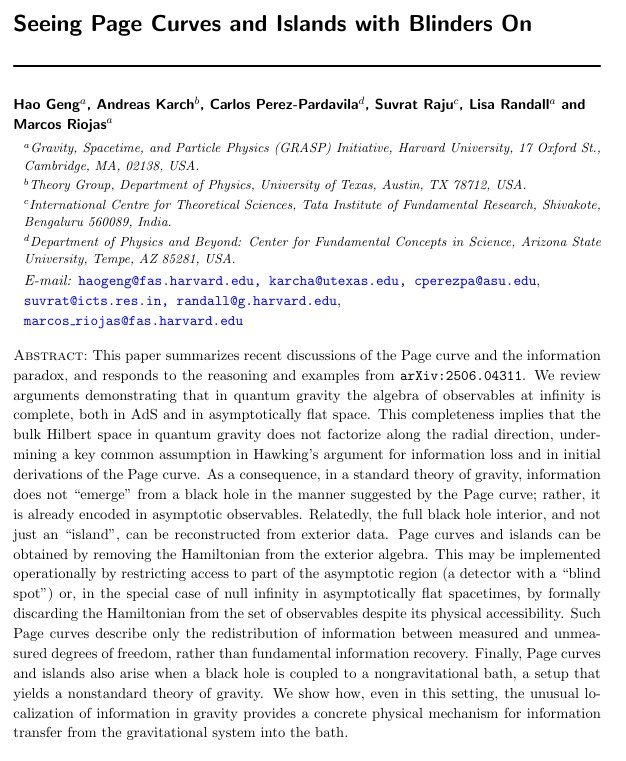
This is why our paper today is titled “Seeing Page Curves and Islands with Blinders On.” We have many more details, including a detailed discussion of “relational observables” and why they can’t be used to make islands consistent; and an explanation of how holography of information is important even in the presence of a bath.
I doubt that there are technical disagreements on any of these points. So, I’ll end with some personal perspective. Arguably, the effect that observables outside a compact region are sensitive to observables inside the region is one of the most interesting facts that we have learned about quantum gravity. It explains how information from the interior ends up in the radiation. So I feel that it makes sense to embrace and explore this physics, rather than finding innovative ways of obscuring it, as one must necessarily do to see a Page curve.