Blog

Various thoughts and advertisements! Posts before 29 August 2026 are an archived copy of public Facebook posts. Comments? Email me.

Locality and Observers in Quantum Gravity

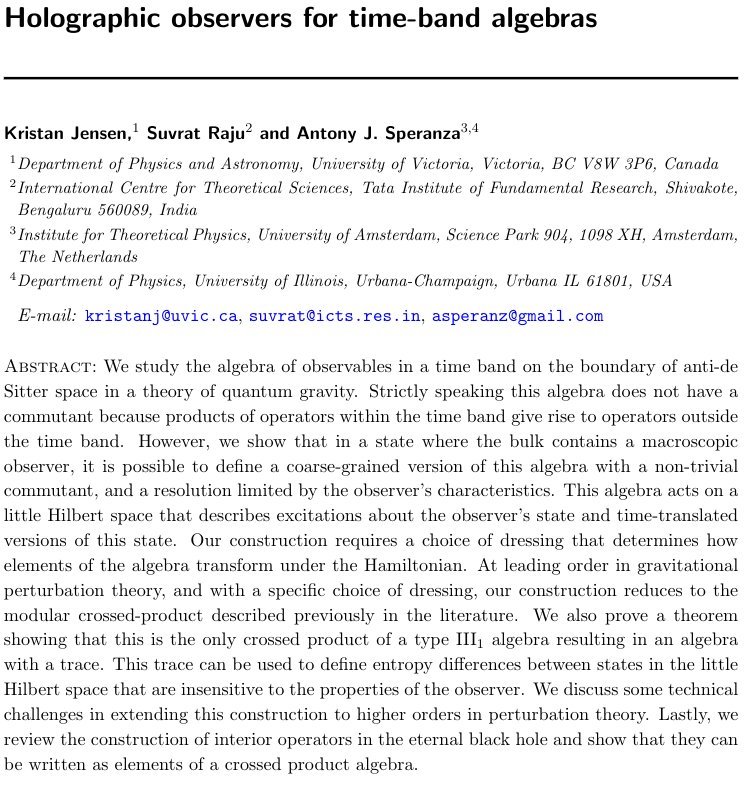
New paper to end the year with Kristan and Antony. Last year, with Jonathan, Antony and Kristan studied quantum information measures for subregions in gravitational theories. Some of their results might appear puzzling if you have been following recent progress on the holography of information. In quantum gravity, information in a bounded subregion is available in its complement. This might suggest that it shouldn’t make sense to measure the information content of a bounded region in gravitational theories.

In today’s paper we reconcile these observations. One should think about the holographic properties of gravity like unitarity. Unitarity is important for precise nonperturbative questions about any system, and can be verified in perturbation theory about simple states, as we do in elementary QFT courses. But, in the presence of a macroscopic background, if we coarse grain our observables — as we do in everyday life — physics appears dissipative. Similarly, holography is important if we ask precise questions about information loss. And, for simple states, one can check perturbatively that gravity localizes information differently from quantum field theories. But, in the presence of a macroscopic observer with coarse-grained abilities, holography can be obscured and this allows one to define “algebras” for bounded regions and their complements and quantify their information content.

The observer needs to be heavier than the cosmological scale but lighter than the Planck scale. In our world, a virus on top of the vacuum would do: the mass of a virus is 10^(-15)g (see the biophysics paper in our refs ) — well above the cosmological scale (410^(-66) g) and well below the Planck scale (210^(-5)g).

Quasilocal observables about macroscopic backgrounds have been studied many times before. But it doesn’t seem to have been noted that, with some jiggling of notation, the formulas used to define these observables go over exactly into the formulas used to define the so-called “crossed product” in the literature on von Neumann algebras. This is not only true for the formulas in today’s paper. We went back and looked at a paper with Kyriakos from 2015, exploring the interior of an eternal black hole, and the crossed product had appeared secretly there as well!

P.S: Just to be clear and to anticipate possibe confusion: these techniques can’t be used to define a meaningful Page curve for black-hole evaporation. The unitarity of black-hole evaporation relies on nonperturbative effects and in this regime, these quasilocal constructions break down. It is an invitation to paradox to conflate everyday intuition about locality with intuition from unitarity, as both Hawking and Page did.

Of course, if one demands that the Page curve should be the answer then one can find the right question by adding nongravitational baths to AdS, or by dividing the boundary into two regions etc. but these curves don’t represent information “emerging” from the black hole; holography of information tells us the information never goes “in”, and so it doesn’t have to emerge.

See http://www.arxiv.org/pdf/2412.21185 for this discussion and more!
Scholasticide and Genocide in Palestine

Last month, as part of Academics for Democratic Rights, we organized a talk by Sundos Hammad and Ahmad Sabobeh who are part of the Right to Education campaign at Birzeit University in Palestine. The talk was titled “Introduction to Scholasticide and Genocide”. Education is a means of empowerment and the speakers explained, powerfully and movingly, how Israel has violently disrupted educational systems in Palestine for decades. It is very important to hear directly from those who are living in Palestine under the occupation. I urge everyone who would like to understand the situation in Palestine to watch this recorded video. Please also share it with others.

https://youtu.be/Lfgsl0GgD7U

Achin Vanaik in Bengaluru: Palestine and the Crisis in West Asia

Updated 18 November 2024

Achin Vanaik will be in Bengaluru to talk about the genocide in Palestine and the crisis in West Asia. We are having a talk at ICTS on Tuesday, 19 November 3:30-5 pm as part of our general talk series. Then, later in the evening, on the same day, there is a public talk at the AITUC office in Malleswaram organized by Bengaluru for Justice and Peace. Please spread the word about the public event and please come if you can.

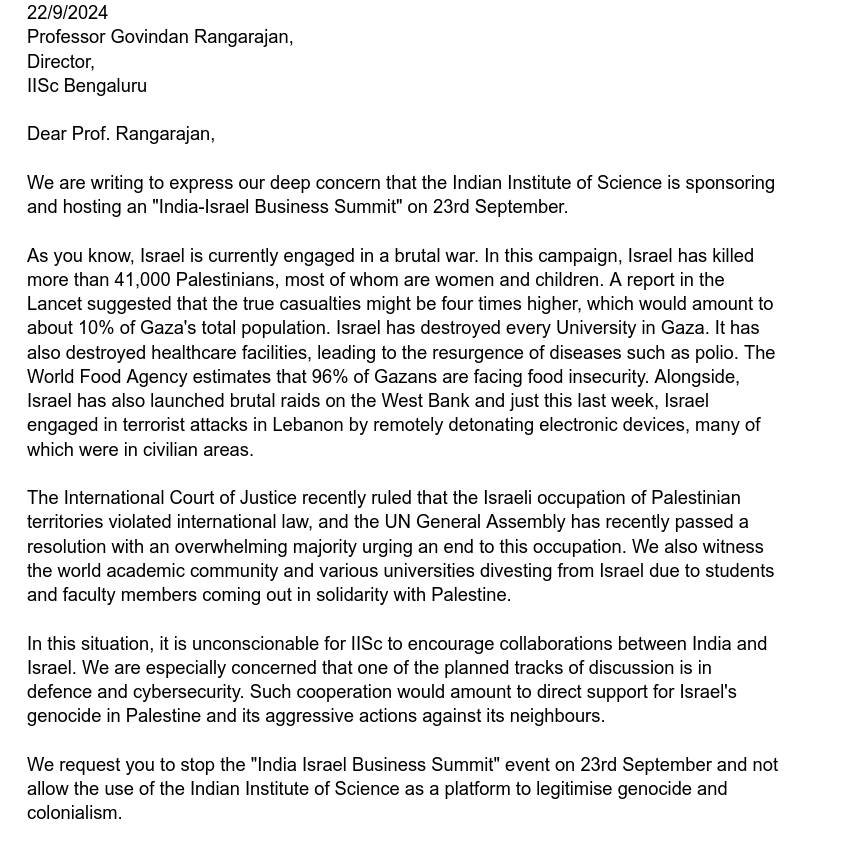
Opposing the India–Israel Business Summit at IISc

IISc seems to think that this is the right time to promote an India-Israel business summit. More than 1500 students and faculty members from across the country, and other members of civil society have written to the Director of IISc expressing their concern. I think one measure of the depth of the outrage in the broader scientific and academic community is that these signatures were collected in a little more than 36 hours.

See the full letter and signatories here: https://docs.google.com/document/d/1KY3l-dfpjfj6oLtXSWhRI4Xv248RdYN2sfFhzO2GLFA/edit

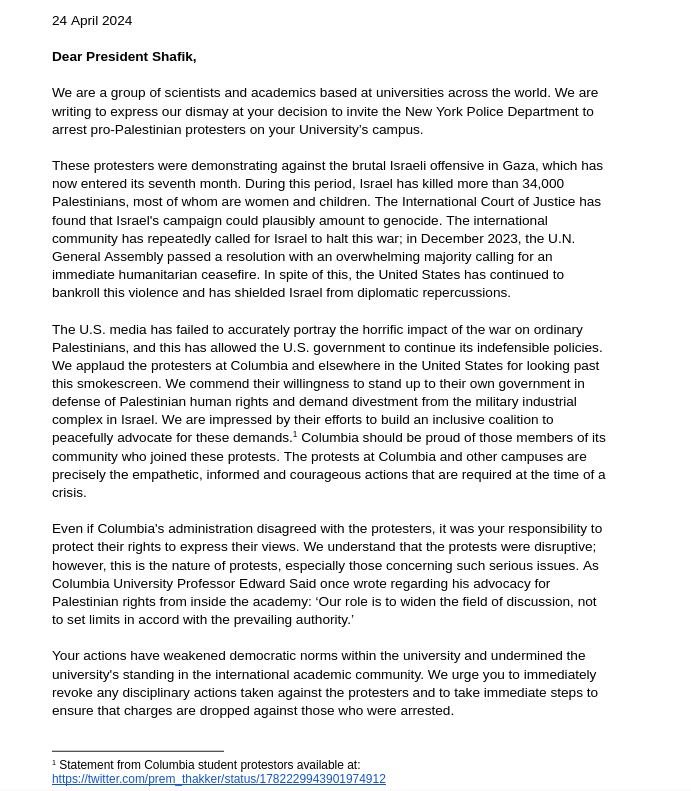
Letter to Columbia University in Support of Student Protesters

Some of us have drafted a letter to the President of Columbia University. The letter is available here: https://docs.google.com/document/d/1siZzqg0PGXVvp3r7Cg4JEXm2_c_vSf37borLj_BmeBA/edit

If you would like to endorse this letter, please use this Google Form: https://docs.google.com/forms/d/114XlojgHuPxD-qk5UOj9SsN3VOpQV0EbeUCfqUSlq88/viewform?edit_requested=true

We plan to send it off to Shafik by the weekend.

The students at Columbia and other campuses are doing the right thing. Their actions are informed, empathetic and courageous.

Are Page curves relevant for real Black Holes?

Vasudev Shyam got Geoff Penington and me to be part of a podcast discussion today morning. We discussed whether islands and the Page curve are relevant for realistic black holes.

As Geoff pointed out at the end, it is good to broaden and democratize these discussions as much as possible, so you can see for yourself: https://www.youtube.com/watch?v=ZCIho8geEfI

The video itself is pretty long so here is, I believe, a reasonable summary of what we agreed and disagreed on:

We agree that information is always outside the black hole for a physical observer. Therefore, in a standard theory of gravity, information doesn’t “emerge” the way that Page argued that it does. I feel that this suggests that deriving a Page curve is not crucial for understanding the information problem. Geoff’s disagrees with this perspective.

We agree that it is possible to find a Page curve if one looks for it. One possibility is to modify the theory by coupling it to a nongravitational bath. In these theories the graviton is massive and information does emerge according to a Page curve.

Alternately, we agree that it is also possible to simply disallow the observer outside the black hole from measuring the components of the metric that correspond to the energy. Such an observer sees a Page curve even in standard gravity.

My perspective was that this Page curve reflects our voluntary choice of disregarding some information that is available at all times. Geoff argued that this was physically natural.