Blog

Various thoughts and advertisements! Posts before 29 August 2026 are an archived copy of public Facebook posts. Comments? Email me.

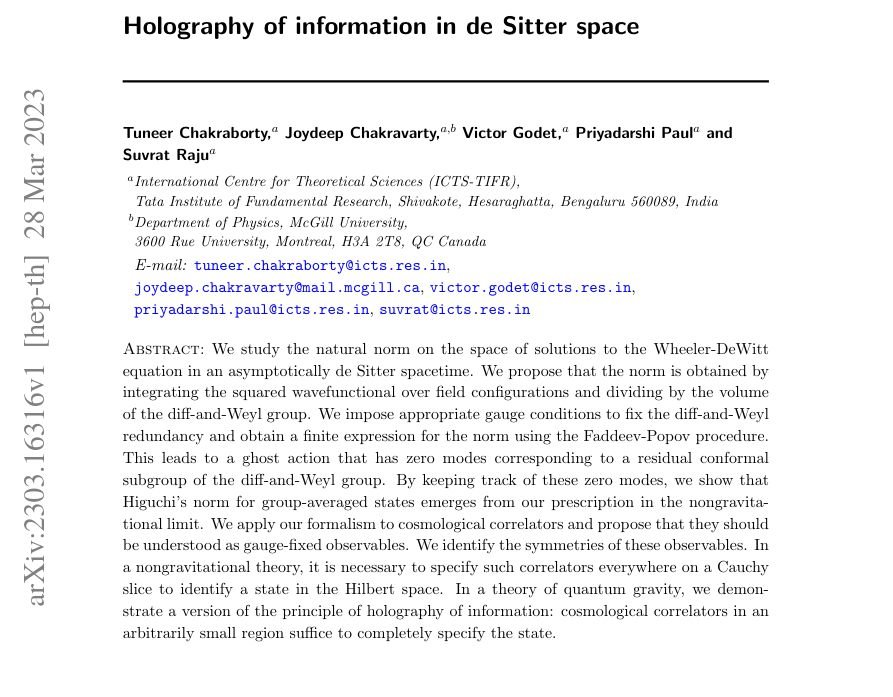
Holography of Information in de Sitter Space

Updated 30 March 2023

And here is the second one (again with Tuneer, Joydeep, Victor, and Priyadarshi. )

https://arxiv.org/pdf/2303.16316.pdf

The question we ask and answer here is: how does the holography of information work in de Sitter space.

The background to this is the idea that gravity localizes information differently from nongravitational theories. In both flat space and in AdS, one can argue that all information on a spatial slice is available near its boundary. This argument doesn’t require AdS/CFT; rather it explains why gravitational theories are holographic.

How should this idea work in dS, where spatial slices have no boundaries?

It turns out that there is a remarkable answer in terms of “cosmological correlators”: cosmological correlators in any small patch of the late-time slice in dS are sufficient to uniquely identify the state!

Intuitively, this result goes back to the symmetries of the states in the dS Hilbert space. The WDW analysis tells us that all valid states have the same symmetries as the Hartle-Hawking state. This leads cosmological correlators to manifest a version of conformal symmetry in all states. Therefore, knowing them in a small open set is equivalent to knowing them everywhere on the spatial slice. Somewhat surprisingly (and somewhat unlike AdS and flat space) our result remains true even if one switches off gravity completely while preserving the Gauss law in the Hilbert space.

The analysis is somewhat technical even if the final result is simple.

We had to start by understanding observables in the de Sitter Hilbert space. We propose that the expectation value of an observable is described by integrating it with a squared wavefunctionals over all field configurations and dividing by the volume of the diff and Weyl group. This is like the functional integral that appears in worldsheet string theory, and we spend a fair amount of time teasing out its form and examining various subtleties.

Moreover, Cosmological correlators, defined as expectation values of products of fields on the late-time de Sitter slice, are not gauge invariant by themselves. So we define them as gauge-fixed observables. Such correlators are labelled by coordinates on the late-time slice but they are secretly nonlocal. So a physical observer (which, separately, is a tricky thing to model in cosmology ) cannot discern the state of the Universe by looking at just a small patch. But, nevertheless, this result is a sharp mathematical difference between theories with gravity and theories without gravity.

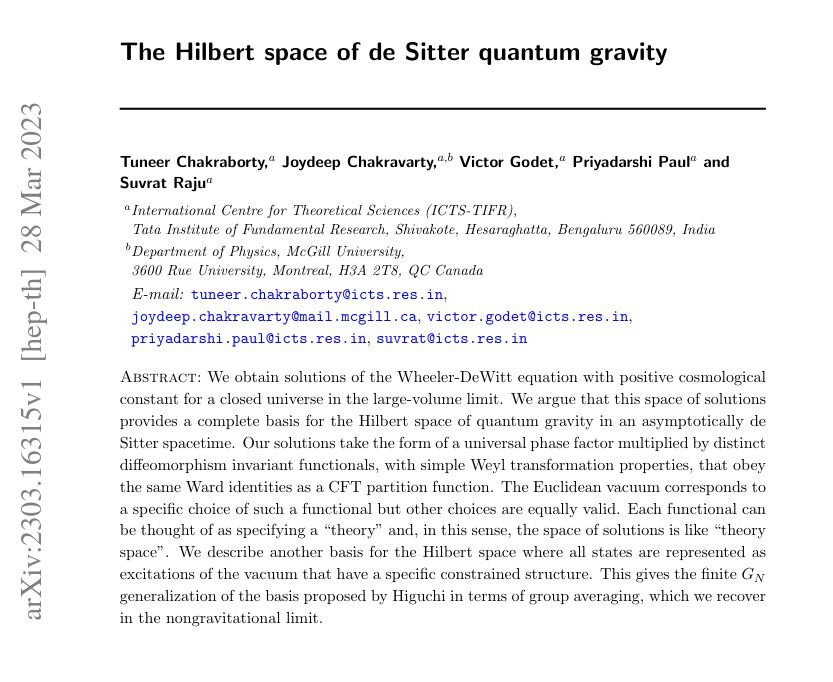
The Hilbert Space of de Sitter Quantum Gravity

I am quite excited about a pair of papers that we put out today with Tuneer, Joydeep, Victor, and Priyadarshi. Here is the first one:

https://arxiv.org/pdf/2303.16315.pdf

The question we ask and answer here is: “What is the right Hilbert space for quantum gravity in de Sitter space?”

At first sight, this might seem trivial: at least perturbatively, why not just start with the Hartle-Hawking vacuum and build a Fock space? This isn’t the right answer because even in the weakly coupled limit it is necessary to impose the Gauss law in a gravitational theory. But the spatial slices of de Sitter are compact. So the Gauss law tells us that valid states should have no charges under any of the de Sitter isometries. In the usual Fock space, the only such space is the vacuum. So does the dS Hilbert space have only one state? :-)

Higuchi studied this question and proposed an answer more than 30 years ago in a paper that is far less known than it should be. Higuchi’s idea was that one should take each element of the Fock space, as a “seed state”, and then “average it” over the isometry group. To define the norm of the group-averaged state, Higuchi proposed that one should use the usual norm divided by the volume of the isometry group.

As someone once said to me, “that sounds crazy. In flat space, we don’t take states and average them over the Poincare group!”

So we went back to the basics. We started with the Wheeler-DeWitt (WDW) equation, which is the fundamental constraint on the gravitational Hilbert space. The technical idea is that the WDW equation — which is usually intractable — simplifies at late times in de Sitter because the volume of the spatial slices becomes large. We don’t even to work perturbatively and, in this limit, can find solutions, whose form is preserved at all orders in perturbation theory.

This leads to many interesting results.

  1. When states are described in terms of wavefunctionals. then we show that a basis of solutions is given by wavefunctional that have a universal phase factor, e^{i S} multiplied with Z, where Z obeys the same Ward identities as a CFT partition function. (The central charge is imaginary, and there are no constraints of unitarity of locality on Z)
  2. The Hartle-Hawking state has this form, but it corresponds to one possible choice of Z. Other choices of Z are perfectly fine. In this sense, our state space is like “theory space.”
  3. All states have the same symmetries as the Hartle-Hawking state. So approximate conformal invariance of the early Universe, were it to be confirmed, would not provide evidence for the no-boundary proposal. It is a general prediction of inflation.
  4. When written in a particular basis, our states reduce to Higuchi’s group averaged states in the nongravitational limit. But beyond G_N -> 0, Higuchi’s construction must be corrected and we show how to do that.

Academic Statement Against Blocking the BBC Modi Documentary

Magic Cards

Updated 6 October 2022

I’m often struck by how differently children think.

My 9.5 year old son is fond of playing the following “magic trick” on his friends. The magician asks the subject to think of a number between, say, 1 and 63. Then the magician shows the subject a set of 6 cards, each of which has numbers written on it, and asks the subject to state “yes” or “no” depending on whether the chosen number is printed on the card. At the end the magician guesses the number.

The principle is simple: n “yes” or “no” answers yield n bits of information and can be used to uniquely encode a number up to 2^n-1. But it appears surprising if one hasn’t thought about it.

The kid wanted to go up to higher powers of 2. So he needed to generate his own “magic cards”, which he decided to do via a small Scratch program. (His initial plan was to print cards up to 2^21 but strict rationing of the use of the printer has limited him to 2^10. )

In any case, the precise question is as follows: “given a number, 2^n, generate n lists so that the k^th list has the property that it contains all numbers up to 2^n whose binary representation has 1 in the k^th place.”

Here is what the kid came up with (see image). Or test the full code here: https://scratch.mit.edu/projects/740194941/

To me, this is a perfect example of obfuscated code! I can never imagine writing this code to solve the problem above. I challenge any of the adults reading this to figure out how the code works without reading it at least thrice. But this was perfectly natural for the child. He wrote it pretty quickly — in under 15 min. And, remarkably, it is not particularly inefficient either in terms of code-size or running-time. (For those who still find the code crytpic, see the discussion with Rukmini below.)

I am sure, in a few years, when he has had more formal training, he will write a “more standard” algorithm for this problem. Just as formal training makes us see hats instead of boa constrictors with elephants.

Excess Mortality During India's COVID-19 Pandemic

Updated 1 July 2022

Recorded video of an important discussion hosted by the Indian Scientists Response to COVID-19. The panel had Rukmini S, Shankar and Prabhat Jha and discussed estimates of excess mortality during the pandemic. I learned a lot while moderating the discussion and I would recommend the entire video.

https://youtu.be/XiByxEeM1X4

The discussion is strictly scientific but this question has broader implications.

The context for the discussion is WHO’s estimate, released a couple of months ago, that there had been about 4.7 million excess deaths in India in 2020-21 due to the COVID-19 pandemic — about ten times the official figure. India is a large country but even in per-capita terms this is an extremely high toll. It puts India in the sorry company of countries like the United States that are well known to have mismanaged the pandemic.

This number is important, not just because we owe it to those whom we lost to at least count them, but also for those who are living. The pandemic served as a test of the public health system and of governance. Therefore an analysis of how these systems performed is revealing and must be used for reform and course-correction.

On the one hand, this high toll reveals systemic weaknesses in our healthcare system. Moreover, the lack of basic social security meant that people were unable to take the steps necessary to protect themselves.

But there is a second question. Given these systemic weaknesses, could India have done better if its government had simply taken better policy decisions during the pandemic?" It is clear that the answer is “yes”.

What is more, the government of India clearly agrees with this. The true death toll shows the failure of its pandemic-management policies. And so it has made the data as inaccessible as possible, and has tried its best to obfuscate issues. It is supported in this endeavour by a bunch of “modellers”, “scientists”, bureaucrats and an enormous propaganda system.

But even if this works for a while, this cannot work forever. There must be accountability. And hopefully the disastrous implications of “administration by masterstroke” — which we have had for a while now — will become clear to more people sooner rather than later.

Recent popular media coverage of black-hole information

Updated 4 April 2022

This is a post about the recent popular media coverage of the black hole information paradox. It is a post that I would have preferred not to make. However, I care about public outreach of science and I think that when scientists engage in outreach, they have some responsibilities. These include not misleading people, not making overblown claims, and not claiming credit for the work of others.

I understand that outreach is difficult, and it is sometimes difficult to avoid oversimplifying issues. But, in the recent stories, I see absolutely no effort to uphold these principles. Given this, I think it is important for other scientists to call this out.

Second, I think this incident provides some interesting insights into how the media operates. Some of the media organizations involved in promoting this story — the BBC, the Guardian, Newsweek and others — claim to be the source of “trusted news”. The story I am about to relate below might help to evaluate this claim.

๐’๐œ๐ข๐ž๐ง๐ญ๐ข๐Ÿ๐ข๐œ ๐›๐š๐œ๐ค๐ ๐ซ๐จ๐ฎ๐ง๐

In October last year, Calmet et al. published a paper arguing for the failure of the no-hair theorem due to quantum effects. The result is not new: it has been known to those who think about quantum aspects of black holes for several years. For instance, see this review I wrote in 2020: https://arxiv.org/pdf/2012.05770.pdf where I stated “if one attempts to use the classical [no-hair] theorem, unchanged, in quantum mechanics, then the theorem is clearly wrong.”

Calmet et al. used different techniques to study the field of two spherically symetric balls of matter and showed that this depends on more than the mass. The results of Calmet et al. do not directly address the information paradox. As Daniel Harlow emphasized in a recent discussion, just knowing the energy cannot even be used to distinguish between pure and mixed states (eg. a|E_1> + b |E_2> cannot be distinguished from |a|^2 |E_1><|E_1| + |b|^2 |E_2><E_2|).

To be clear: it has been my position for a few years (which not everyone agrees with) that the information paradox can be resolved by replacing the no-hair theorem by a principle of holography of information. This is the result, which we have developed with several collaborators that, in an appropriate UV-completion of gravity, all the information inside the black hole is available outside, which is very different from the no-hair theorem.

But the results of Calmet et al. do not establish such a principle and should not be conflated with our results. They only establish a more-limited result: that some information is available outside.

To summarize: this paper is a reasonable incremental advance that provides a supporting calculation for an existing perspective. The result is not unexpected, and was known earlier, although the authors developed new techniques that are of interest.

๐“๐ก๐ž ๐Œ๐ž๐๐ข๐š ๐๐ฅ๐ข๐ญ๐ณ

A couple of weeks ago, the University of Sussex, which is the home institution for two of the authors of the paper above, decided to go on a publicity blitz. The blitz was timed with the journal-publication of this paper and a companion paper (in PLB and PRL). Journal publication means very little in hep-th, but journalists don’t know this and think of “peer-review” as some mystical magical process.

I first learned of the U. Sussex publicity stunt when I was contacted by the BBC asking for comments on a study “which claims to resolve the Hawking paradox.” I was quite puzzled about what the BBC was talking about, but after some back and forth, I was given a copy of the actual press-release from U. Sussex and the paper from October 21.

The press release skipped over the state of the scientific field and claimed a dramatic result well in excess of what was claimed in the paper itself.

I tried to be positive about the paper. But I kept pointing out to the BBC that this work didn’t represent a fundamentally new perspective. However, the BBC kept pressing me for a quote that would fit their story. The final quote they used came from this exchange:

====== BBC: Does this resolve the information paradox?

Reply:

I think this insight — the failure of the no hair theorem — does resolve the information paradox as it was formulated by Hawking.

However, it would be demonstrably incorrect to attribute this insight to the recent work of Calmet et al.

I think the correct and verifiable statement is that “in the past few years, it has been recognized that the no hair theorem fails due to quantum effects and this resolves Hawking’s paradox.”

The recent paper provides additional evidence for the failure of the no-hair theorem when quantum mechanical effects are included.

=====

Some word of this got back to the authors. So, a day later, I received a nice email from one of the (non-Sussex) authors who explained that I shouldn’t take the U. Sussex PR department too seriously since they were just “doing their job” and getting the science right was “only secondary” in this job. I largely forgot about the matter, and assumed that now that the BBC had been pointed in the right direction, they would ignore the U. Sussex PR machine, do their own research and write some kind of a balanced popular science article on a better understanding of quantum information in quantum gravity.

How naive! A few days later, the following BBC story appeared. You can read it for yourself here and form an opinion. Note also the truncaton of my quote. (more on this below). https://www.bbc.com/news/science-environment-60708711

The U. Sussex pitch to BBC offered it an “exclusive”. But similar stories soon appeared in the Guardian, the Independent, the Daily Mail and several other British media outlets. From there, it was picked up by media outlets across the world. Even our own News 18 in Hindi. A Google news search will reveal hundreds of similar stories.

As far as I can see, the authors have made no attempt to correct this overblown coverage.

๐€ ๐Ÿ๐ž๐ฐ ๐ช๐ฎ๐ž๐ฌ๐ญ๐ข๐จ๐ง๐ฌ ๐Ÿ๐จ๐ซ ๐ฌ๐œ๐ข๐ž๐ง๐œ๐ž ๐ฃ๐จ๐ฎ๐ซ๐ง๐š๐ฅ๐ข๐ฌ๐ญ๐ฌ:

  1. A uniform characteristic of all these stories is that they almost entirely conform to the University press release and at most have a single external quote for form. How do science journalists make an assessment of the quality or importance of the work? For instance, the BBC decided the Calmet et al. paper was “revolutionary”. But I am the only external scientist quoted in the story. My opinion was the one given above. So how did the BBC reach this conclusion? Do they have in-house experts on quantum aspects of black holes who assessed the paper for them?

Same question for the Guardian — the supposedly sober representative of establishment British journalism. It decided that this might possibly represent a “momentous advance.” (See: https://www.theguardian.com/science/2022/mar/17/quantum-hair-could-resolve-stephen-hawking-black-hole-paradox-say-scientists) ) But the sole external scientist quoted is Toby Wiseman who correctly expressed skepticism about the paper. So how did the Guardian arrive at this assessment?

Some news organizations, like the Daily Mail decided to dispense with the external expert entirely! So do they usually believe whatever a PR agency tells them, without even bothering to ask even one neutral knowledgeable person?

I think this is important for reasons that go beyond this story. Why should these news organizations be trusted to perform “fact checks” and weed out “fake news” that they keep complaining about, if this is how they do their job in relatively objective areas like physics.

As far as I can see, they decided to simply blindly trust the University press release because the University was British. (I bet they wouldn’t have published anything if more established researchers on the information paradox geographically based outside Western Europe or the United States had sent this story to them.)

Given this touching faith of the British mainstream media in British institutions, is it surprising that they swallowed — hook, line and sinker — stories about WMDs when the British government told them about it?

Another problem is that these news outlets have more credibility than they deserve. So once they publish something, news outlets in other parts of the world follow their lead. Obviously, this is a serious and broader problem.

  1. Are the science journalists at these organizations trained in doing basic literature searches? As of 25 March, Inspire-HEP shows that this paper has zero published citations, once self-citations are excluded.

To be clear: citations are a very flawed measure and I believe they are influenced by all sorts of non-scientific factors. They largely reflect networks of scientists citing each other and so it may well happen that papers with few citations are important.

But, even then, didn’t “zero citations in five months” send up some red flags for journalists? It means that the paper hasn’t created any immediate splash in the community that works on the subject. Shouldn’t this have encouraged some due diligence?

  1. Are science journalists at these organizations trained to check if scientists are claiming novelty where it doesn’t exist? A simple Google scholar search would have revealed that failure of the no-hair theorem and its implications for the information paradox has been investigated in print well before this paper. For instance a Google scholar search with keywords “no hair theorem, quantum mechanics, information paradox” will throw up the review above. So even a small amount of research should have been sufficient, even for non-specialists to recognize that the perspective of Calmet et al. is not fundamentally new.

  2. Do science journalists who write such stories even bother to read the paper they are reporting on and see if it conforms to the news release? In this case, the scientific paper itself doesn’t make the claims that the press-release does. Are the journalists aware of the following two-step possibility: (a) scientists write a paper and get it published (b) they issue a press-release that notionally refers to the paper, but actually has little to do with the contents of the paper.

๐€ ๐ช๐ฎ๐ž๐ฌ๐ญ๐ข๐จ๐ง ๐Ÿ๐จ๐ซ ๐จ๐ญ๐ก๐ž๐ซ ๐ฌ๐œ๐ข๐ž๐ง๐ญ๐ข๐ฌ๐ญ๐ฌ

Obviously, experts in the subject are uniformly amused at these articles. Within this small community, these news articles don’t do the authors any good. But we are fooling ourselves if we think that these stories don’t matter. They are read by our colleagues in adjacent offices who work in related areas. They are read by undergraduate and graduate students who make career-decisions based on them. So what should be done to counter this?

Many of us are wary of aggressive publicity of this kind since it is hard to do good outreach without misleading people. But this just leaves the door open to disigenuous media-blitzes of the kind above that do a significant amount of harm.