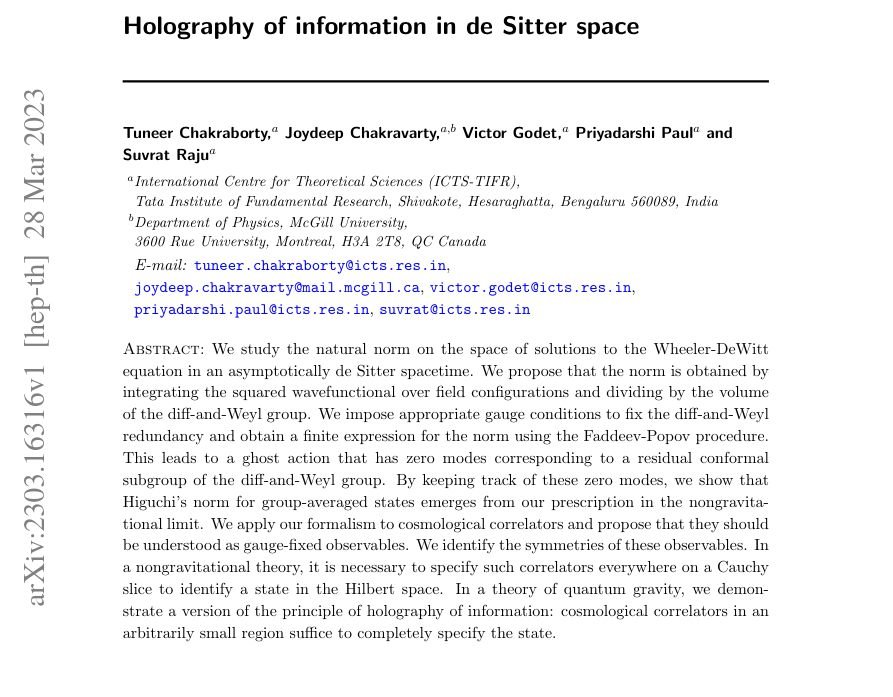
And here is the second one (again with Tuneer, Joydeep, Victor, and Priyadarshi. )
https://arxiv.org/pdf/2303.16316.pdf
The question we ask and answer here is: how does the holography of information work in de Sitter space.
The background to this is the idea that gravity localizes information differently from nongravitational theories. In both flat space and in AdS, one can argue that all information on a spatial slice is available near its boundary. This argument doesn’t require AdS/CFT; rather it explains why gravitational theories are holographic.
How should this idea work in dS, where spatial slices have no boundaries?
It turns out that there is a remarkable answer in terms of “cosmological correlators”: cosmological correlators in any small patch of the late-time slice in dS are sufficient to uniquely identify the state!
Intuitively, this result goes back to the symmetries of the states in the dS Hilbert space. The WDW analysis tells us that all valid states have the same symmetries as the Hartle-Hawking state. This leads cosmological correlators to manifest a version of conformal symmetry in all states. Therefore, knowing them in a small open set is equivalent to knowing them everywhere on the spatial slice. Somewhat surprisingly (and somewhat unlike AdS and flat space) our result remains true even if one switches off gravity completely while preserving the Gauss law in the Hilbert space.
The analysis is somewhat technical even if the final result is simple.
We had to start by understanding observables in the de Sitter Hilbert space. We propose that the expectation value of an observable is described by integrating it with a squared wavefunctionals over all field configurations and dividing by the volume of the diff and Weyl group. This is like the functional integral that appears in worldsheet string theory, and we spend a fair amount of time teasing out its form and examining various subtleties.
Moreover, Cosmological correlators, defined as expectation values of products of fields on the late-time de Sitter slice, are not gauge invariant by themselves. So we define them as gauge-fixed observables. Such correlators are labelled by coordinates on the late-time slice but they are secretly nonlocal. So a physical observer (which, separately, is a tricky thing to model in cosmology ) cannot discern the state of the Universe by looking at just a small patch. But, nevertheless, this result is a sharp mathematical difference between theories with gravity and theories without gravity.