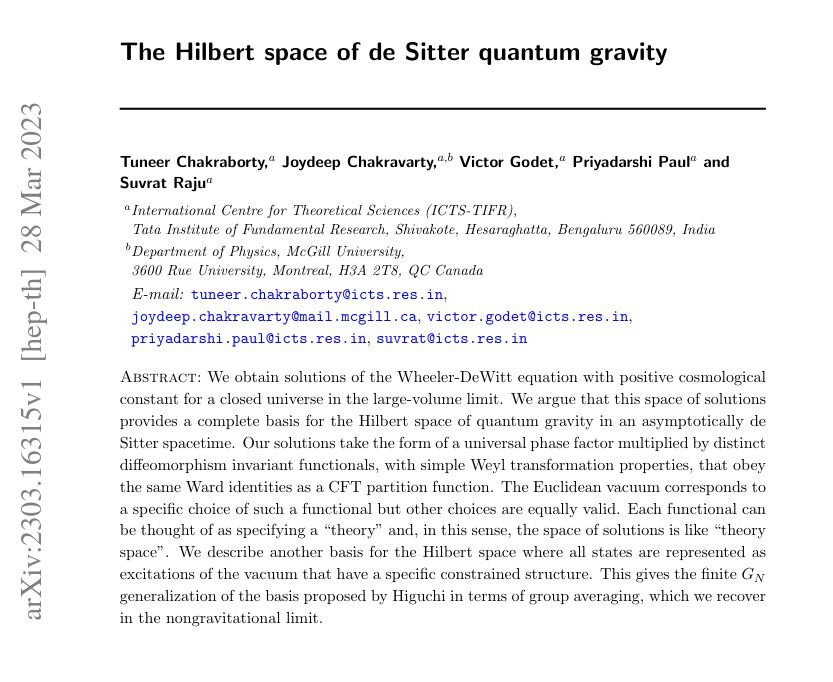
I am quite excited about a pair of papers that we put out today with Tuneer, Joydeep, Victor, and Priyadarshi. Here is the first one:
https://arxiv.org/pdf/2303.16315.pdf
The question we ask and answer here is: “What is the right Hilbert space for quantum gravity in de Sitter space?”
At first sight, this might seem trivial: at least perturbatively, why not just start with the Hartle-Hawking vacuum and build a Fock space? This isn’t the right answer because even in the weakly coupled limit it is necessary to impose the Gauss law in a gravitational theory. But the spatial slices of de Sitter are compact. So the Gauss law tells us that valid states should have no charges under any of the de Sitter isometries. In the usual Fock space, the only such space is the vacuum. So does the dS Hilbert space have only one state? :-)
Higuchi studied this question and proposed an answer more than 30 years ago in a paper that is far less known than it should be. Higuchi’s idea was that one should take each element of the Fock space, as a “seed state”, and then “average it” over the isometry group. To define the norm of the group-averaged state, Higuchi proposed that one should use the usual norm divided by the volume of the isometry group.
As someone once said to me, “that sounds crazy. In flat space, we don’t take states and average them over the Poincare group!”
So we went back to the basics. We started with the Wheeler-DeWitt (WDW) equation, which is the fundamental constraint on the gravitational Hilbert space. The technical idea is that the WDW equation — which is usually intractable — simplifies at late times in de Sitter because the volume of the spatial slices becomes large. We don’t even to work perturbatively and, in this limit, can find solutions, whose form is preserved at all orders in perturbation theory.
This leads to many interesting results.
- When states are described in terms of wavefunctionals. then we show that a basis of solutions is given by wavefunctional that have a universal phase factor, e^{i S} multiplied with Z, where Z obeys the same Ward identities as a CFT partition function. (The central charge is imaginary, and there are no constraints of unitarity of locality on Z)
- The Hartle-Hawking state has this form, but it corresponds to one possible choice of Z. Other choices of Z are perfectly fine. In this sense, our state space is like “theory space.”
- All states have the same symmetries as the Hartle-Hawking state. So approximate conformal invariance of the early Universe, were it to be confirmed, would not provide evidence for the no-boundary proposal. It is a general prediction of inflation.
- When written in a particular basis, our states reduce to Higuchi’s group averaged states in the nongravitational limit. But beyond G_N -> 0, Higuchi’s construction must be corrected and we show how to do that.