Blog

Various thoughts and advertisements! Posts before 29 August 2026 are an archived copy of public Facebook posts. Comments? Email me.

Is Holography Implicit in Canonical Gravity?

New essay asking “Is Holography Implicit in Canonical Gravity?” The precise conjecture is that if two solutions of the Wheeler-deWitt equation coincide near the boundary of anti-de Sitter space at one point of time, then they must be equal. (i.e. they cannot differ even in the bulk.)

https://arxiv.org/abs/1903.11073

Of course, such a claim cannot hold in the classical theory—where it is easy to construct metrics and matter configurations that differ in the bulk but coincide asymptotically—but the essay lays out some evidence that the quantum theory does have this property.

This property might not sound surprising to string theorists but in talking to people who work in canonical gravity, I often get the impression that they think of holography as something mysterious that emerges from the ultraviolet properties of string theory. The suggestion here is that this is not the case, and holography is implicit even in the low-energy canonical formulation of quantum gravity.

If you have comments, please send them to me, especially if you find the argument provocative/wrong/obviously right!

(This post comes with the usual apologies to my non-physics friends if Facebook puts this on your timeline.)

Foxing Stockfirst: Solution

After the chess puzzle in my previous post, there was a lot of discussion about chess programs, but no one seems to have attempted the puzzle itself :-) Its a difficult puzzle, but the solution is also really beautiful and it helps to explain why engines don’t find it. So I thought I would devote another post to it. If you want to try the puzzle yourself, please stop reading here.

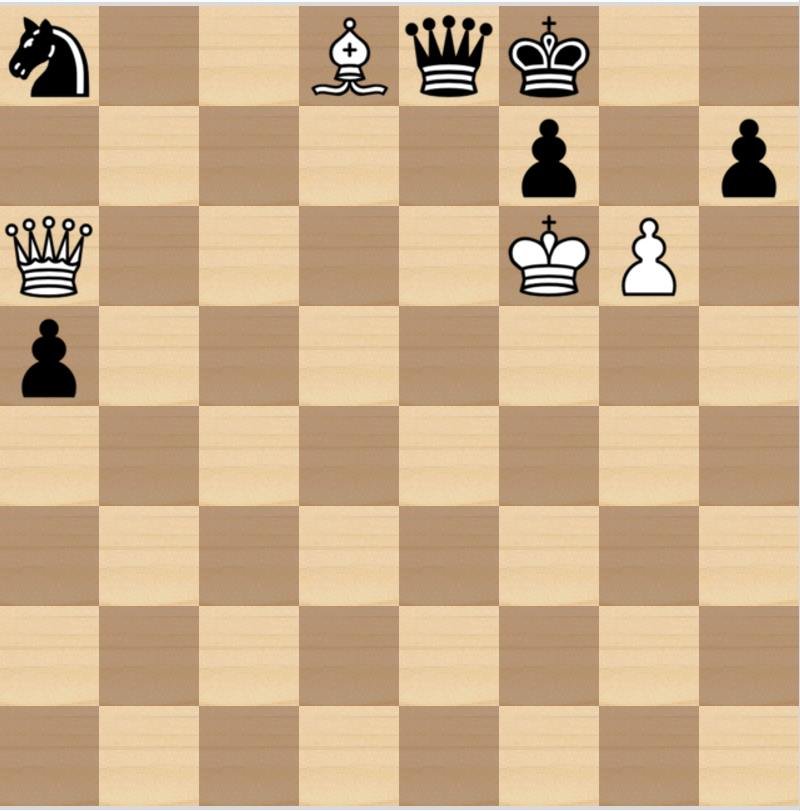
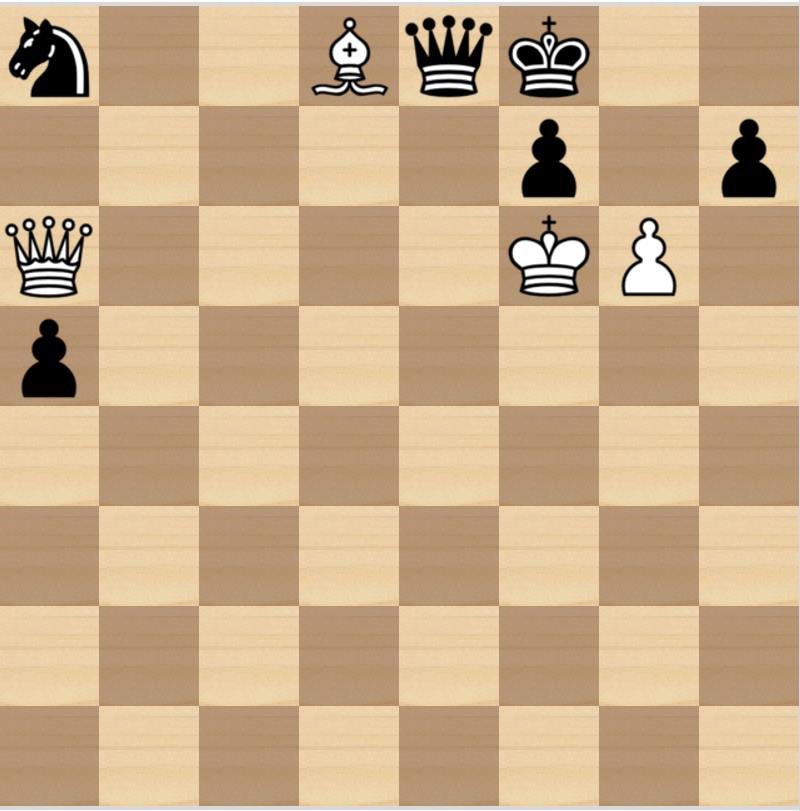
To recap, the initial position is the one on the left. With white to play, the correct continuation is 1.Qc8 Kg8 2. Bc7!

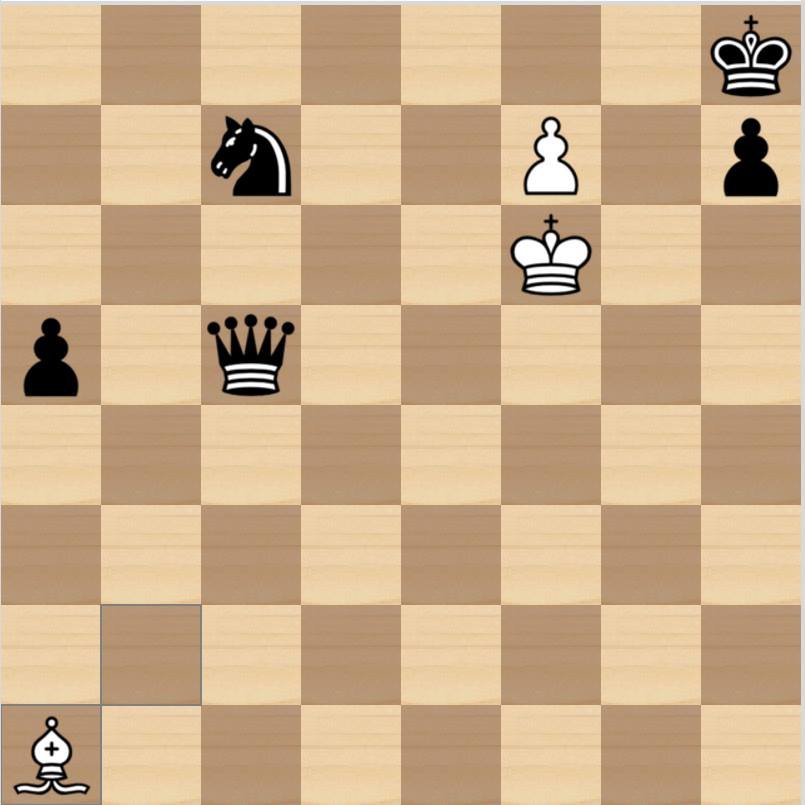
This is the move that engines cannot find, since it involves a immediate huge loss of material and the payback is only because of a positional novelty that manifests itself several moves down the line. So presumably, most algorithms just prune this move. After this move is played, engines can find the continuation, which is: 2. …Qxc8 3.gxf7+ Kh8 4.Be5 Qc5 5.Bb2 Nc7 6.Ba1

This brings us to the position in the second figure below. Now Black is not, strictly speaking, in zugzwang. But Black will be in zugzwang after 4 moves! Play continues 6. … a4 7. Bb2 a3 8.Ba1 a2 9. Bb2 a1=Q 10. Bxa1 Qe5+ 11. Bxe5 Nd5+ 12. Ke6+ Nf6 13. Bxf6#

Foxing Stockfish

At my son’s children’s chess tournaments, I sometimes meet a gentleman who rails against the recent advances in artificial intelligence. “Machines lie”, he roars. “Even in chess, they have no positional understanding.” Usually, I just listen quietly but one day I decided to floor him with a gotcha! “So, show me a position where Stockfish makes a demonstrable mistake. Not just one in which your positional judgment disagrees with Stockfish.” And to my surprise, he immediately produced the first position below.

This is actually a mate in 13, but Stockfish misses the winning line even after hours of analysis. It is true that specialized mate-finding programs will find the solution, but can you find the mate yourself? Feel free to post solutions in the comments. I’ll post the right answer a little later :-)

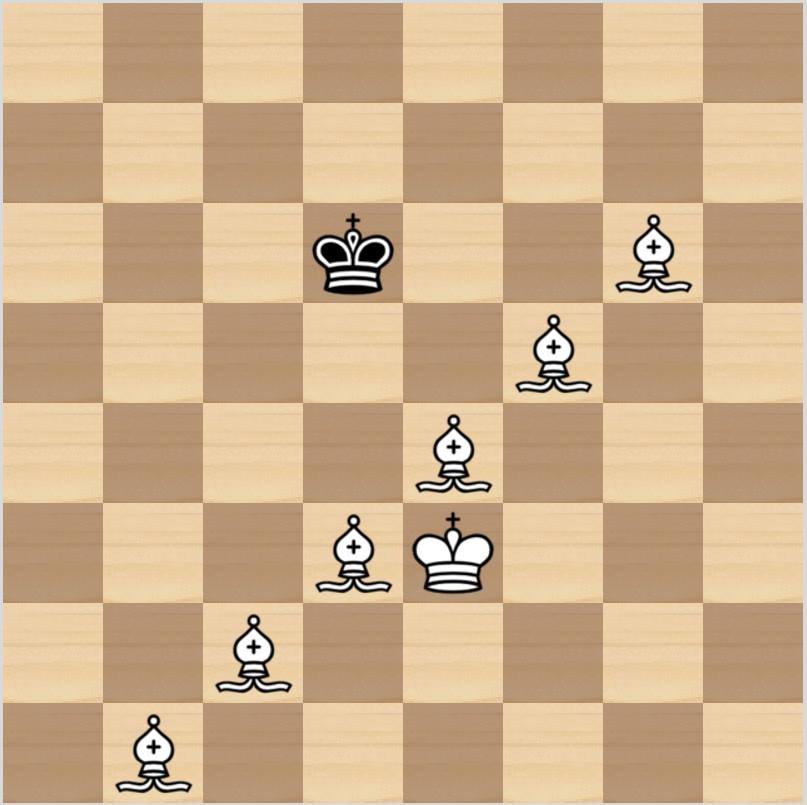
A few weeks later, I had another conversation with him. This time, he showed me the second position below (with the multiple white bishops). Stockfish tells me that the evaluation is +20.7. Of course, its obvious to a child that the correct evaluation is 0.

I’m not sure what to make of these examples. Do they show something deep about the lack of versatility of machines? Or are they just curiousities with no broader implications? I’m curious to hear what people think. [Fine print: I suppose the interesting question is whether machine-learning programs do better. I tried both positions with Lc0. There are so many possible parameters and possible weight files that I cannot make a general statement. But with the weight file I used, Lc0 couldn’t find the first mate. But I’m glad to say that it correctly evaluated the second position, although if I understand its algorithm correctly, this was almost guaranteed.]

A Talk on a Toy Model for the Information Paradox

Following the last post, I got a number of additional questions about the paper presenting a toy model for the information paradox. This is a talk I gave at a workshop in Princeton some time ago. The organizers at the Institute for Advanced Study did a really nice job (as usual!) in recording the audio clearly and combining it with the slides. If someone would just like to understand the basic idea, and some parts of the calculation in the paper seem a little technical, then this may be a useful resource. (This is a specialized seminar, so this post comes with advance apologies to my non-physics friends if Facebook shows this on your news feed!) https://www.youtube.com/watch?v=1QDQp7JbV8E

Bell Correlators and the AMPS Paradox

Not a new paper but, in this version, I’ve added some comments on the difference between gauge theories and gravity and the relevance to the AMPS paradox, about which I got a number a questions.

It seems to have been clear for a while that the resolution to the Mathur/AMPS paradox is that operators in the black-hole interior can be expressed as complicated combinations of operators outside. This was also a feature of the construction of the interior that Kyriakos Papadodimas and I set up. However, I’ve long felt that it would be nice to have a toy model where this could be demonstrated as cleanly as possible with no conjectures or hand waving. This paper sets out such a model.

The technical tool is to use Bell correlators to express the monogamy of entanglement. (Bell correlators are far better controlled than the von Neumann entropy). Then one can show that that, even in empty AdS, if one is allowed to use arbitrarily complicated operators from distinct regions, it is possible to violate the monogamy inequalities precisely like the Mathur/AMPS paradox. Moreover, everything can be calculated cleanly, with explicit numbers. In this model, I violate the monogamy inequalities by 42.5%!

What this shows is that, in quantum gravity, operators which appear to be in different regions may secretly be acting on the same degrees of freedom and so can access the same quantum information.

It is important that this phenomenon appears only in gravity, and not in gauge theories. In gauge theories, because there exist exactly local gauge-invariant operators, one cannot read off information about interior excitations from a far-away region; someone could act with a little localized Wilson loop in the interior, while leaving every observable for the far-away observer invariant. So, while in gauge theories, operators from different regions may not commute because their Wilson lines intersect, “complementarity” (in the sense described above) seems to be a feature unique to quantum gravity.

Comments (especially critical ones!) are welcome. https://arxiv.org/abs/1809.10154

A conversation in Delhi

I had a sad and startling conversation with a taxi driver the day before yesterday. I had gone to Ashoka University to give a talk, and the ride to Delhi airport is almost a couple of hours. I hadn’t seen the news in the morning, and when I saw the news on my phone, I expressed my disgust at the escalating tensions to the taxi driver: “अरे देखो कितना ख़राब हो रहा है.” At which point, he looked at me and said: “तो हम क्या करें? उन्होंने हमारे लोगों को मारा, तो क्या चुप बैठें ? अब चाहे हमारे लाख मर जाएँ, उनके ज़्यादा मारेंगे.” So I tried to explain the futility of war etc. and the problem in Kashmir at which point he says: “वो लोग तो पत्थर फेंकते हैं. मैं अगर फ़ौज में वहां होता तो बंदूक से सब को उड़ा देता.” So we went on talking for a while, and I kept trying to tell him about how matters were not so simple. He was surprisingly receptive. By the end of the journey, he started saying, “हाँ ,शायद इमरान खान भी ठीक बोल रहा है. उसको मौका देना चाहिए” and about Kashmir, " हाँ, भारत सरकार ने भी कुछ गलत किया होगा इसलिए कश्मीर के लोग नाराज़ होंगे. So, I was happy with my persuasive skills and while getting off, I told him “और लोगों से भी बातचीत करना और यह सब समझाना” at which point he replied “मैं यह सब बात नहीं कर सकता. मुझे पाकिस्तानी कहेंगे. मैं तो वैसे भी मुसलमान हूँ. अगर हिन्दू होता तो शायद कह पाता” I was absolutely dumbstruck. It turns out he had agreed with me all along, but because of his identity, he was terrified to express himself honestly. Even though I was obviously anti-war, he nevertheless felt compelled to pretend to be a bloodthirsty war-mongerer. Someone else said something similar to me yesterday. There must be something really wrong …

Bounds on Thermal Relativistic Correlators

We considered relativistic correlation functions at finite temperature in the limit where the momenta of the operators become spacelike and large. Surprisingly, these correlators are bounded by a beautiful geometric quantity: they must die off at least as fast as exp[-R/T] where R is the radius of the smallest sphere that encloses the nonplanar polygon formed by the momenta and T is the temperature. https://arxiv.org/abs/1902.07203