Blog

Various thoughts and advertisements! Posts before 29 August 2026 are an archived copy of public Facebook posts. Comments? Email me.

Lessons from the Information Paradox

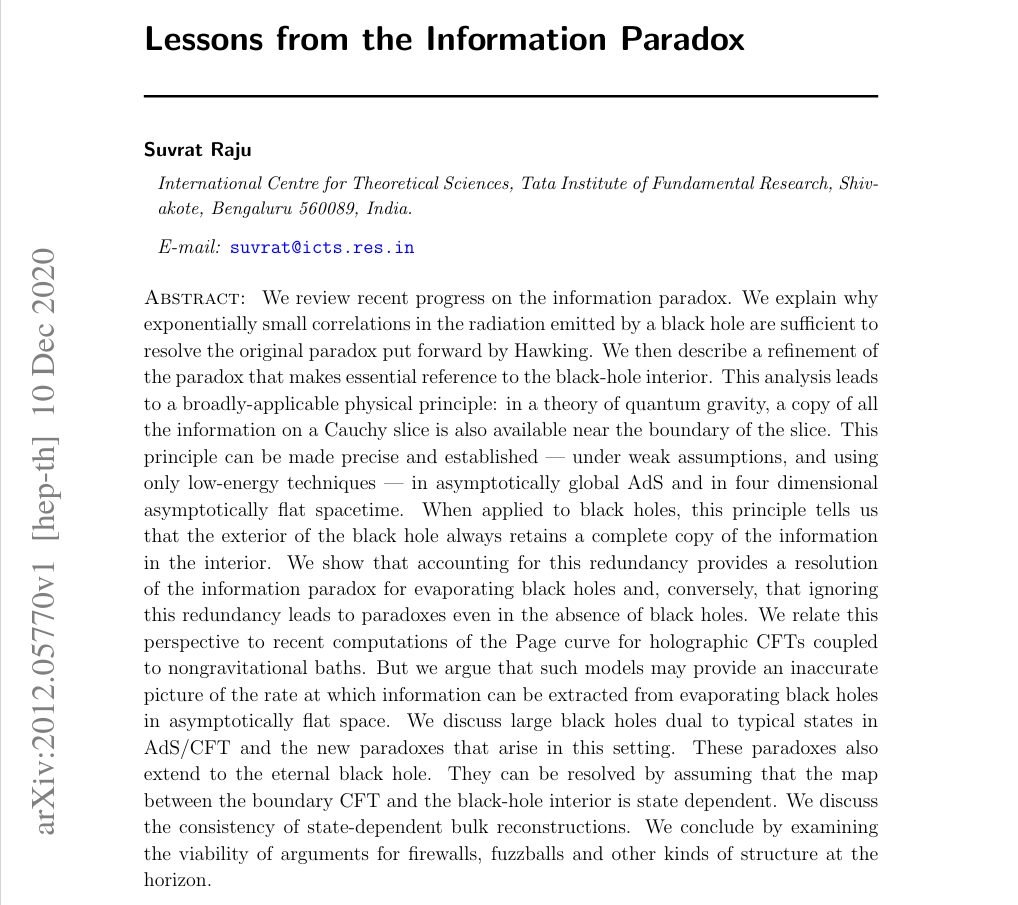
Here is another article that appeared today, reviewing some of the lessons that I think the information paradox teaches us about broader aspects of quantum gravity. https://arxiv.org/pdf/2012.05770.pdf

I started this article with the plan of writing up some of the discussions we had at the summer conferences. But then I realized that there were many ideas that people were talking about that were not explained clearly in any one place. So I kept writing … and kept writing … and when I finished, I found that I was at 156 pages :D As they say, in runner’s parlance, that’s a PB.

But I tried my best to write a coherent story about an old subject; to emphasize the main physical ideas with as few technicalities as possible and provide the background material necessary to understand these ideas. In fact the only parts that are somewhat technical are about issues that are conceptually well understood.

So although the article is long, I hope that it will still be fun to read, and useful.

And send me comments if you have any.

Information Transfer with a Gravitating Bath

Updated 10 December 2020

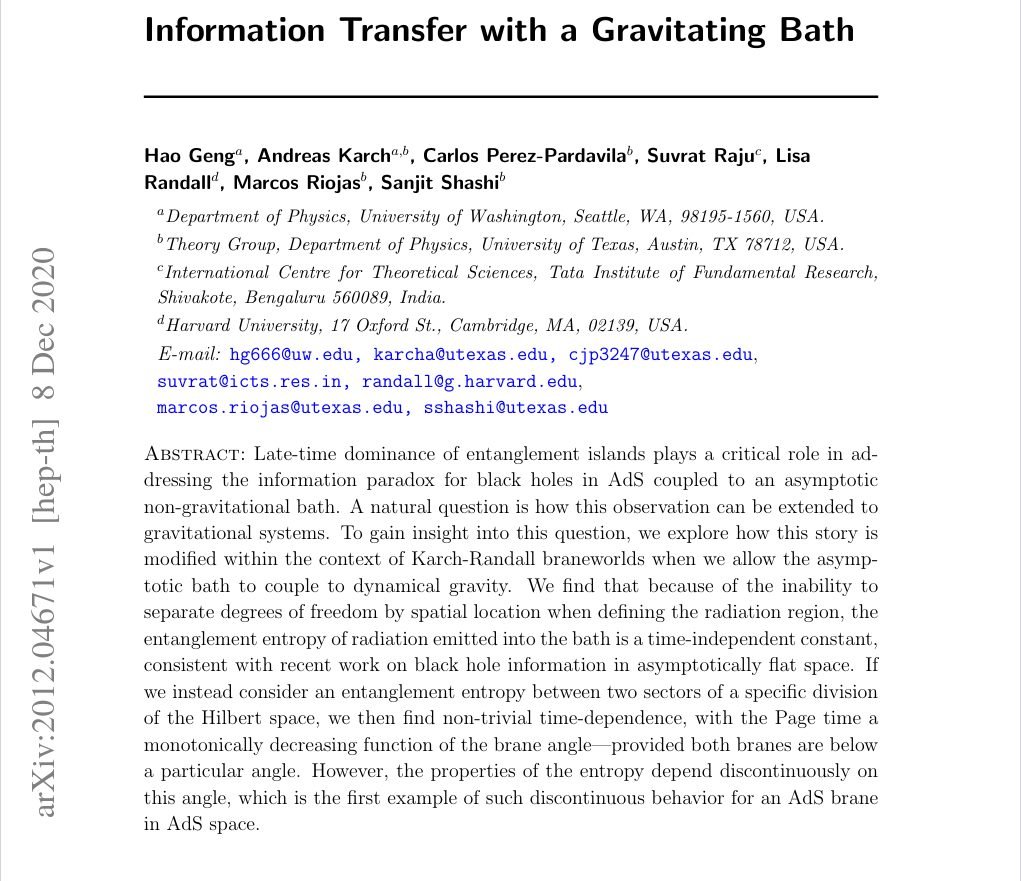
We have (in my unbiased opinion :-) ) an interesting paper out today: https://arxiv.org/pdf/2012.04671 with Hao Geng, Andreas Karch, Carlos Perez-Pardavila, Lisa Randall, Marcos Riojas, and Sanjit Shashi. One of the significant problems we managed to solve was to “how to set up multiple Zoom meetings across four time zones on opposite sides of the world.”

More seriously, there has been a lot of recent activity on computing the entropy of “Hawking radiation” using entanglement islands. However, the precise computations actually deal with black holes that are rather different from black holes in our world. More specifically, they generally consider an entire holographic system that has an asymptotic AdS region of its own, which is then coupled to a nongravitational bath. As several of us have pointed out, it is not clear if the lessons learned from such setups hold when gravity is everywhere dynamical, as it is in our world.

So the idea of today’s paper was to turn on gravity in the bath itself. This can be done elegantly in the braneworld scenarios that have been used for higher-dimensional computations (and that were studied by Andreas and Lisa long ago) by just introducing a second brane into the geometry. And, lo and behold, when we do this, the Page curve disappears!

So we find that the nongravitational bath is not just a calculational device, but it modifies the physics in a significant way. This is also precisely what one would expect from our previous work on black holes in asymptotically flat space: we pointed out that when gravity is dynamical, information about the black-hole interior is always available outside, and so there should be no Page curve for the fine-grained entropy of radiation. On the other hand, there might be other questions one could ask that might yield a Page curve.

And indeed, even in the setup of today’s paper, there is still a codimension 2 boundary that is nongravitational. On this nongravitational boundary, we can divide the Hilbert space into two parts. If we ask about the entanglement between these two parts, we recover a Page curve. This Page curve has many interesting properties, and islands play a role provided the branes obey some interesting geometric constraints.

This Page curve is answering a nongravitational question, that can nevertheless be studied by analyzing minimal surfaces in a dual geometry. It is not a Page curve that describes how information “emerges” from a black hole.

I think this is also how previous Page-curve computations should be interpreted. One takes a nongravitational theory, maybe N=4 SYM, and divides it into two parts. Or maybe one takes a SYK model and couples it to a CFT. There is no gravity in sight. But when the theories have a bulk dual, it is still possible to compute the entanglement between these two subsystems using bulk extremal surfaces.

So the Page curves that have been computed should not be interpreted as telling us the rate at which information is transferred from the black hole into the radiation; rather they are telling us about how information is transferred from one nongravitational region to another.
BHI Talk

Updated 4 November 2020

I’ve never physically been in the U.S. on the day of a presidential election, but at least I got to be there virtually yesterday at the Black Hole Initiative at Harvard!

BHI colloquium recording

Holography of Information: Talks at Stanford and Perimeter

Updated 7 October 2020

Here are some talks I gave at Stanford and at Perimeter in the past couple of weeks on the “Holography of Information from semiclassical gravity.” The talks cover somewhat similar ground, but the emphasis is slightly different because the Perimeter talk was aimed at a non-string theory audience, whereas the Stanford talk was for a string-theory audience.

Perimeter: http://pirsa.org/displayFlash.php?id=20090001

Stanford: https://stanford.zoom.us/rec/play/UewZOtxyYd1v0s-xOErSUZehU9oFB54uEzFYFeWdA_Rf5mhwo-DIeGn5dSHbccuguLFvs1WDOjJ5OqMy.XiAGe6h-M6DELocW

P.S: And I cannot help adding that the time-difference between North America and India is as bad as possible. Yet, all I had to do was start at 8:30 am one morning, and end at 10:30 pm one evening. Its probably a sign that I am getting older, but I can’t honestly say that I miss the jet-lag or that we should all go back to it when this ends.

Eradicate Nuclear Weapons Before They Eradicate Us

Tomorrow (4 Sept), I’m going to speak at a webinar titled “Lets eradicate nuclear weapons before they eradicate us.” This is jointly organized by Rotary clubs in Cochin, Karachi and Michigan. I think there are a number of very interesting talks. Please attend if you can and spread the word. One needs to register in advance here for the Zoom link: https://docs.google.com/forms/d/e/1FAIpQLSc5use3IADdls9g34hHtTjcbl6tdSjHkrlbSJAuBvaN9AXm7g/viewform

QASTM Seminar

Updated 3 September 2020

I’m going to describe some of our recent work in the QASTM seminar hosted by Sayantan tomorrow. I’ll try and keep the discussion as simple as possible, so please come and ask questions. (update: recorded video here https://www.youtube.com/watch?v=wYgCFKlwJ3E)

QASTM seminar recording

Recording: Asking Questions about Mathematical Models

Updated 16 August 2020

The recorded video for the Chai and Why discussion today on “Asking questions about mathematical models” is available here: https://youtu.be/sWTU0KsJj3U

Thanks very much to Chai and Why? and to March For Science Mumbai for organizing the event, and for giving me the opportunity to discuss these issues.

This event marked National Scientific Temper Day which is observed on 20 August to commemorate Dr. Narendra Dabholkar.

There were many questions after the talk, but if there are more questions or comments, please send them over.

Asking Questions about Mathematical Models

I’m going to lead a virtual discussion tomorrow (Sunday, 16 Aug, 11 AM) as part of the TIFR Chai and Why series titled: “Asking questions about mathematical models”. I promise to keep the discussion very simple. So if you have been reading (or writing) about these models, it may be of interest. Here is a more detailed abstract. Please come if you can and spread the word to others who might be interested.


The past few months have seen the emergence of numerous mathematical models, accompanied by claims from the models’ originators to have uncovered key insights about the COVID-19 pandemic. But in several cases, models with obvious flaws have received wide publicity. I will discuss, among other examples, early model-based claims that a “49 day lockdown” was necessary in India, and later claims that the Indian lockdown “averted thousands of deaths”. These are textbook examples of poor science, but they also show how governments and others with an agenda can use scientific-sounding claims to mislead people. I will conclude by arguing that mathematical models can be useful tools, but they cannot be treated as black boxes: we must carefully examine the assumptions and methodology of each individual model before we take its conclusions seriously.


Asking Questions about Mathematical Models — Chai and Why